Liquid rhinoplasty is a cosmetic procedure that uses injectable fillers to reshape the nose without surgery. By strategically placing dermal fillers along the nasal bridge, tip, or sidewalls, an experienced injector can smooth bumps, correct asymmetry, and refine your profile in under an hour. As a non surgical rhinoplasty option, it delivers immediate results with minimal downtime-but since the fillers are temporary, the question everyone asks first is: how long will it actually last?
This guide covers everything you need to know, from realistic timelines and filler types to aftercare, risks, and when a surgical nose job might be the better path.
Learn more: Body Contouring at Leva Medical
What Is Non Surgical Rhinoplasty / Nose Filler?
A non surgical nose job is a procedure in which dermal fillers are injected into specific areas of the nose to alter its shape without cutting bone or cartilage. Non surgical rhinoplasty uses dermal fillers for temporary changes to the nasal profile, making it a popular treatment option for patients who want to enhance their appearance without committing to a surgical procedure.
The key differences from traditional rhinoplasty come down to permanence and recovery. Surgical rhinoplasty permanently alters the nose's shape and size through osteotomies, cartilage grafts, and tissue removal. It requires general anesthesia and longer recovery time-often weeks before returning to normal activities. A liquid nose job, by contrast, adds volume to reshape contour rather than removing bone or cartilage, and most patients walk out the same day.

How Long Do Results From Liquid Rhinoplasty Last?
Liquid rhinoplasty results typically last 9 to 18 months. Most fillers used in liquid rhinoplasty last for a year or more, with literature reviews of multiple studies reporting an average range of 9 to 13 months for hyaluronic acid fillers. Results duration varies based on filler type and metabolism, so your experience may fall anywhere within that window. Non surgical rhinoplasty typically lasts 9 to 18 months depending on several patient-specific and product-specific variables.
Factors That Shorten Filler Longevity
Individual metabolism affects how quickly fillers are broken down in the body. People with faster metabolic rates tend to see results fade sooner.
Filler breakdown can be influenced by factors like diet and smoking, both of which increase oxidative stress and inflammatory activity.
High chronic stress and UV exposure can accelerate the breakdown of fillers.
Injection technique, including depth and area, affects filler longevity. Superficial placements tend to degrade faster than deeper ones.
Areas with more movement (like the nasal tip during smiling or speaking) experience greater mechanical stress and faster resorption.
Factors That Extend Filler Longevity
Filler longevity is influenced by the type and density of the filler used. Higher-viscosity, more crosslinked products resist enzymatic breakdown longer.
Deeply placed fillers over the nasal bone tend to last longer than superficial injections, because the supraperiosteal plane is stable and low-movement.
Fillers placed in the nose often break down slower compared to other facial areas, since the nose is relatively static.
Repeat treatments may extend duration. Some practitioners report results lasting up to 24 months after subsequent sessions, likely due to filler-stimulated collagen production.
Avoiding smoking, excessive sun, and chronic stress helps preserve your results.
Dermal Fillers Used In A Non Surgical Nose Job
Hyaluronic acid fillers are commonly used in liquid rhinoplasty, accounting for roughly 97% of all nonsurgical rhinoplasty treatments. Restylane, Perlane, and Juvederm are preferred hyaluronic acid fillers among plastic surgeons and injectors performing this cosmetic procedure.
Fillers typically last between 9 to 18 months in the nose, but the specific product matters. Thicker fillers take longer to metabolize in the body. Some thicker hyaluronic acid formulas can persist up to two years, especially at the radix or dorsum where they sit over stable bone.
Calcium hydroxyapatite (CaHA) is a less common alternative with longer potential duration (12–18+ months) and collagen-stimulating properties. However, it is stiffer, less forgiving, and not easily reversible.
Liquid rhinoplasty fillers can be reversed with hyaluronidase. Hyaluronic acid fillers are reversible with hyaluronidase, an enzyme that breaks down the filler quickly if overcorrection, asymmetry, or vascular complications occur. This safety net is a major reason HA remains the standard for facial fillers in this procedure.
Filler viscosity and stiffness (measured by G′ or elastic modulus) directly impact how long results hold. Higher G′ fillers resist deformation and maintain dorsal height longer but may feel slightly firmer initially.
What Liquid Rhinoplasty Can Correct (Including Nasal Tip)
A liquid nose job can address several common aesthetic concerns:
Nasal tip refinement: Small amounts of filler can increase tip projection, correct a drooping tip, or smooth the transition between tip and dorsum. However, major structural rotation or reduction of the nasal tip still requires surgery.
Dorsal hump camouflage: Filler injected above and below a bump creates a visually straighter profile without removing bone. This is one of the most popular applications.
Minor asymmetry correction: Small differences between sides-slightly deviated bridges, uneven dorsal lines-can be camouflaged with precise placement.
Radix depression filling: Building up the root of the nose between the eyes creates a smoother bridge line and can change how the nose relates to other facial features.
Post-surgical irregularities: Patients who previously had surgery but have contour irregularities or small depressions may use filler to smooth results without a revision surgical procedure.
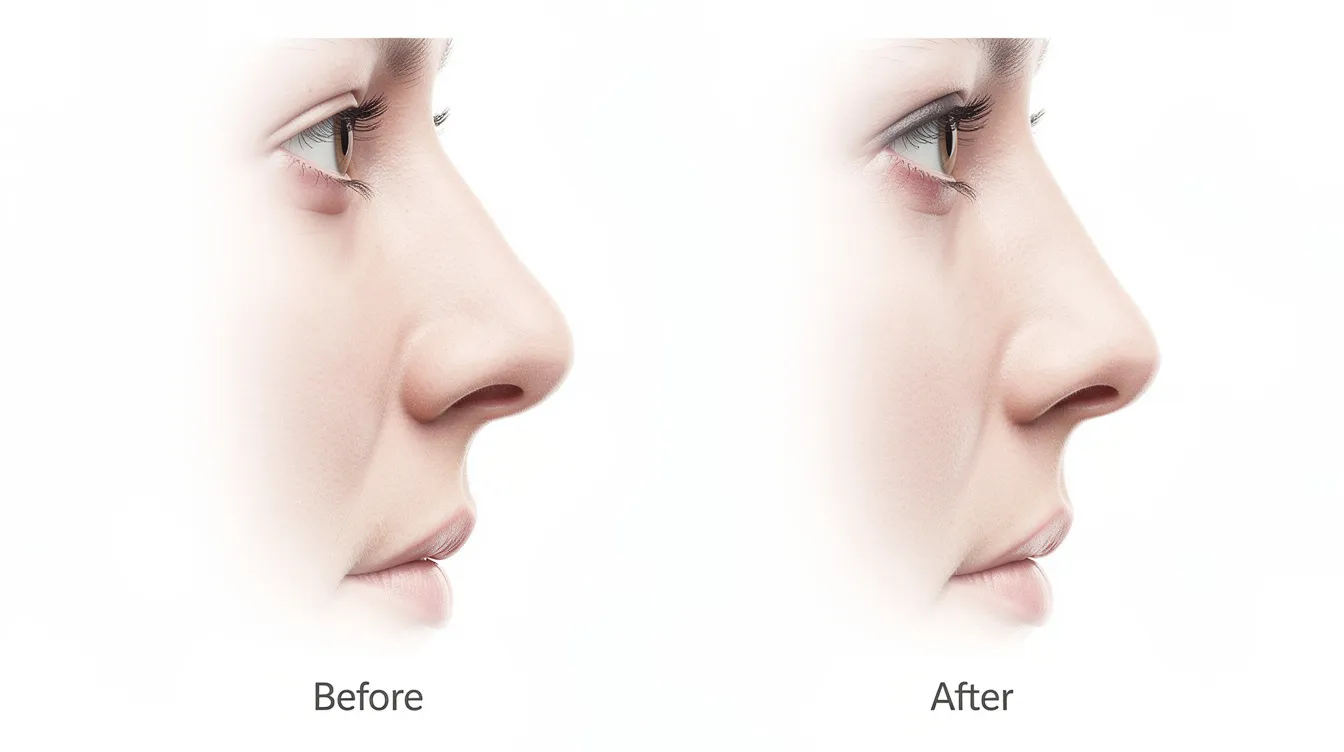
Limitations: When A Surgical Nose Job Is Necessary (Nose Smaller)
Liquid rhinoplasty adds volume and cannot make the nose smaller. If your cosmetic goals involve reducing overall nasal size, narrowing a wide bridge, or decreasing nostril flaring, you'll need a surgical nose job. Filler reshapes by adding-it cannot remove tissue.
Structural issues that require surgical rhinoplasty include:
Excess cartilage or bone causing a large nasal framework
Wide nasal base or flared nostrils
Severe deviation or major asymmetry
Thick skin limiting external definition
Functional breathing problems-septal deviation, internal valve collapse, turbinate hypertrophy-also fall outside the scope of injectable fillers. Patients with these concerns should be referred to a surgeon who can address both form and function. In these cases, many patients ultimately undergo plastic surgery for a permanent solution.
Who Is A Good Candidate For Nonsurgical Rhinoplasty
You're likely a good candidate for nonsurgical rhinoplasty if you're seeking minor changes to your nasal contour rather than a dramatic overhaul. Ideal patients want to smooth a small bump, fill a depression, or subtly refine their profile with a temporary solution before committing to permanent change.
Requirements include:
Realistic expectations about what filler can and cannot achieve
Overall good health with no active nasal infections
No uncontrolled bleeding disorders or allergic reaction history to filler ingredients
No recent surgical rhinoplasty (most injectors recommend waiting at least 12 months post-surgery)
Patients with thick skin may see less crisp definition. Those expecting permanent results or a significantly smaller nose are better served by consulting board certified plastic surgeons.
Procedure Steps For A Nonsurgical Nose Job
The treatment takes about 15 to 30 minutes once preparation is complete. Non surgical rhinoplasty can be performed in about 30 minutes from start to finish. Here's how it typically unfolds:
Consultation: Your injector reviews your medical history, previous surgeries, filler history, and cosmetic goals. Photographic analysis and nasal anatomy evaluation (skin thickness, cartilage support, vascular mapping) guide the treatment plan.
Numbing: A topical anesthetic is applied to the nose. Some injectors also use local infiltration for deeper numbing. You'll feel slight pressure but minimal pain.
Injection: The filler used is injected via a fine needle or cannula at the planned injection site locations. The injector works in small amounts, checking shape and symmetry as they go.
Documentation: Before-and-after photos are taken to capture the baseline and immediate results for follow-up comparison.

Recovery, Aftercare And Downtime
One of the biggest draws of a nonsurgical nose job is the minimal downtime. Most patients return to normal activities the same day or the next. Here's what to do after your treatment:
Apply ice to reduce swelling and discomfort
Avoid strenuous exercise for 24–48 hours
Don't press, massage, or wear glasses on the bridge of your nose for at least 48 hours
Sleep with your head slightly elevated
Avoid alcohol, saunas, and hot tubs for 24–48 hours
Signs to monitor for complications:
Worsening pain or severe discoloration at the injection site
Blanching, mottled skin, or delayed capillary refill (possible vascular occlusion)
Vision changes (seek emergency care immediately)
Warmth, pus, or signs of infection
If any of these appear, contact your provider immediately. Rapid treatment with hyaluronidase can prevent serious complications.
Side Effects And Risks Of Liquid Rhinoplasty
Liquid rhinoplasty carries potential risks and side effects, though many patients experience only mild, short-lived reactions.
Common minor side effects:
Swelling at and around the injection site
Redness lasting a few days
Bruising and mild tenderness
These typically resolve within a week. Common side effects include swelling, redness, and bruising-all manageable with ice and patience.
Serious risks:
The nose is a higher-risk area for filler injections due to its vascular anatomy. Vascular complications can disrupt blood supply to tissue, potentially leading to skin necrosis or, in extremely rare cases, vision loss. Warning signs include sudden blanching, severe pain during injection, and any vision changes.
Serious complications are rare with skilled providers. In a large systematic review of 9,657 patients, the incidence of severe complications was approximately 0.27%. A separate series of 5,000 nonsurgical rhinoplasties reported infection rates of 0.04% and skin necrosis rates of 0.06%.
Choosing experienced injectors dramatically reduces risks. Always verify that your provider is board certified, has specific experience with nasal filler, and keeps hyaluronidase on hand for emergencies.
How To Achieve Natural Looking Results
The difference between a subtle refinement and an overfilled appearance comes down to technique and restraint.
Conservative, layered placement: Injecting small amounts in stages rather than large boluses prevents overcorrection and allows the injector to sculpt precisely.
Review before-and-after galleries: An injector's portfolio reveals how certain modifications to the nose actually look on real patients. Look for natural looking results with smooth contours, not dramatic changes.
Staged touch-ups: Many experienced providers recommend starting with minimal volume, then scheduling a refinement session 2–4 weeks later. This gradual approach reduces the risk of overfilling and lets the body settle into its new shape.
Understanding individual skin thickness, cartilage support, and ethnic variations in anatomy also matters. An injector who accounts for these will produce results that enhance your appearance without looking "done."
Maintenance Options And Longevity Strategies
Since a liquid rhinoplasty is a temporary solution, maintenance is part of the equation. Some patients may require touch-ups around a year after treatment, while others maintain their shape for 18 months or longer depending on the filler used and their individual metabolism.
Typical touch-up intervals:
Most practitioners recommend retreatment every 9–12 months for hyaluronic acid fillers
Some patients schedule earlier touch-ups at 6 months to maintain optimal contour
Choosing longer-lasting products:
For areas like the radix or dorsum where structure matters most, thicker, higher-crosslinked fillers may be a better choice. At the nasal tip or under thin skin, softer products feel more natural but may need earlier refreshing. Discuss these trade-offs with your provider during treatment planning.
The permanent alternative:
If you're tired of maintenance appointments and want permanent results, surgical rhinoplasty remains the definitive option. Once bone and cartilage are reshaped, the changes are lasting-though surgical recovery time is measured in weeks, not hours, and the procedure is not reversible.
FAQ: Can Liquid Rhinoplasty Make My Nose Smaller?
No. Liquid rhinoplasty adds volume to reshape contour-it cannot reduce nasal size. Filler can camouflage visual irregularities and create the illusion of a straighter, more balanced nose, but it won't shrink the overall structure. If your goal is to make your nose smaller by removing bone or cartilage, you'll need to consult with plastic surgeons about a surgical approach.
FAQ: How Soon Will I See Results?
Results are visible immediately after the filler is injected. However, swelling can temporarily obscure the final shape. The true contour typically settles within 5 to 14 days as swelling subsides. Many patients notice their best results about two weeks post-treatment.
FAQ: Can The Filler Be Dissolved?
Yes. Hyaluronic acid fillers can be dissolved using hyaluronidase, an enzyme that breaks down the HA rapidly. This is used for overcorrection, asymmetry, or emergency vascular events. Calcium hydroxyapatite fillers, however, are not fully dissolvable, which is one reason HA remains the preferred choice for most injectors performing this procedure.
FAQ: Is Liquid Rhinoplasty Painful?
Pain is minimal. A topical anesthetic is applied before injection, and some providers use local anesthesia for added comfort. During the procedure, you may feel slight pressure or a pinprick sensation. Afterward, mild soreness, tenderness, and short-lived discomfort are normal and typically resolve within a few days. The body adjusts quickly.
FAQ: Can I Get Surgical Rhinoplasty After Fillers?
Yes. Surgery is possible after fillers dissolve naturally or are removed with hyaluronidase. Most surgeons recommend waiting until all filler has fully degraded before performing a surgical procedure-and it's critical to document your filler history (type, volume, dates) so your surgeon can plan accordingly. Many surgeons advise waiting at least 12 months after the last injection before scheduling surgery, allowing the nasal tissue to return to its baseline state.

Liquid rhinoplasty offers a flexible, low-commitment path to refining your nasal profile. With results lasting 9 to 18 months and a security of knowing hyaluronic acid fillers can be reversed, it's an accessible treatment option for patients who want to test-drive changes before considering anything permanent. The key is choosing the right provider-verification of their credentials, experience with nasal anatomy, and approach to conservative placement will make all the difference.
If you're considering a nonsurgical nose job, your next step is booking a consultation with a board certified injector who can evaluate your anatomy, discuss filler options, and build a treatment plan tailored to your cosmetic goals.
Frequently Asked Questions
How long do liquid rhinoplasty results typically last?
Liquid rhinoplasty results typically last 9 to 18 months. Most hyaluronic acid fillers average 9 to 13 months, though duration varies based on filler type, individual metabolism, and other patient-specific factors.
What factors cause filler results to fade more quickly?
Faster metabolism, smoking, high chronic stress, and UV exposure accelerate filler breakdown. Fillers placed superficially or in high-movement areas like the nasal tip also degrade faster than deeper placements.
Can liquid rhinoplasty results be extended or made to last longer?
Using thicker, more crosslinked fillers and deeper placements over nasal bone can extend results. Avoiding smoking, excessive sun, and chronic stress may help preserve fillers. Some practitioners report results lasting up to 24 months after repeat treatments.
What fillers are most commonly used in liquid rhinoplasty?
Hyaluronic acid fillers account for approximately 97% of nonsurgical rhinoplasty treatments. Common brands include Restylane, Perlane, and Juvederm. These fillers are reversible with hyaluronidase if needed.
What happens if I'm unhappy with my liquid rhinoplasty results?
Hyaluronic acid fillers can be reversed with hyaluronidase, an enzyme that breaks down the filler quickly if overcorrection, asymmetry, or complications occur. This provides a safety option unavailable with permanent procedures.


-2.jpg?width=2000&height=2000&name=Copy%20of%20YouTube%20Thumbnail%20-%20Life-Changing%20Cosmetic%20Surgery!%20(Document)-2.jpg)


